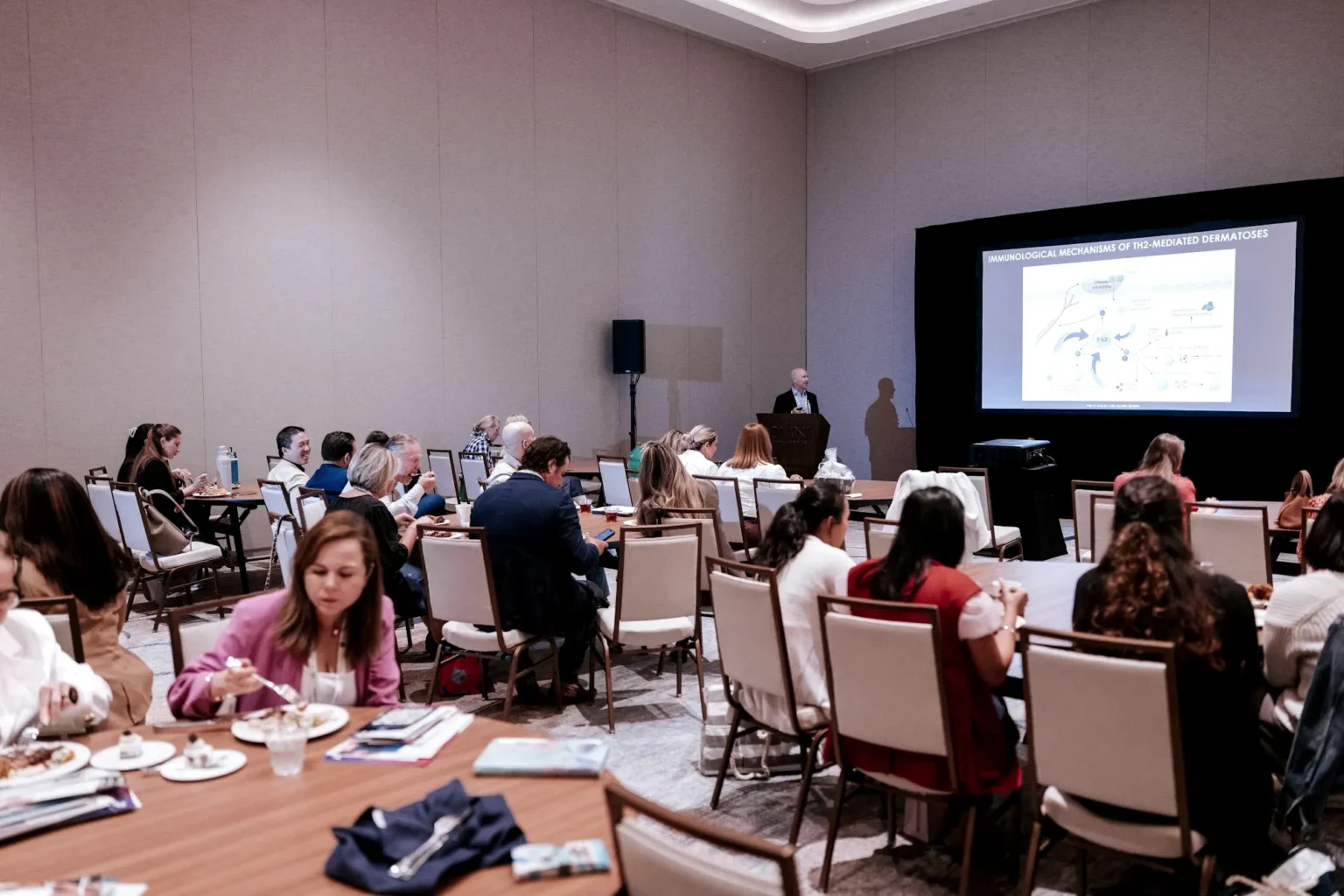
A patient with atopic dermatitis might see a pediatrician first, an allergist when food becomes a worry, and a dermatologist when topical therapy stops working. Each specialty sees part of the picture. The patient lives with all of it.
Who sees atopic dermatitis, and how?
Everyone who touches skin sees it, and each specialty sees it through a different lens. Atopic dermatitis (AD) is most commonly diagnosed in the first six months of life, and it does not stay in pediatrics: a US cross-sectional study estimated adult prevalence at 7.3%. That is far more patients than dermatology can see alone.
Dermatology
Dermatology sees a chronic inflammatory skin disease with a disrupted barrier. The questions are severity, the differential (contact dermatitis and other mimics), and when to step up from topicals to phototherapy or systemic options, including biologics targeting type 2 inflammation and JAK inhibitors.
Allergy and immunology
Allergy sees a type 2 immune pattern that often shows up in more than one organ. The questions are food allergy, asthma, allergic rhinitis, and when testing helps versus when a positive result reflects sensitization rather than clinical allergy.
Primary care
Primary care sees the whole patient over years: sleep, school or work, mood, family history, and adherence. It is often the first visit and the most frequent one.
All three views are correct. None is complete.
Each specialty sees part of the picture. The patient lives with all of it.
What do the atopic march and comorbidities mean for the team?
They mean AD is rarely only a skin problem. The atopic march describes a pattern in which AD often comes first, followed by IgE-mediated food allergy, asthma and allergic rhinitis, conditions that share genetic and environmental risk factors and a type 2 immune response, according to a 2018 review in Annals of Allergy, Asthma & Immunology.
It is a pattern, not a rule. The same review notes the march is not present in every atopic patient, and in one analysis of two birth cohorts only about 10% followed the classic sequence. The practical meaning: a child with early AD deserves a team that watches for the next manifestation without assuming it.
In adults, the American Academy of Dermatology's guidelines on comorbidities found strong evidence linking AD with other atopic conditions, immune-mediated diseases, mental health disorders, bone health conditions and skin infections. They found some evidence for substance use, ADHD and elements of metabolic syndrome, and a small association with some cardiovascular conditions.
Read that list again and notice how few items sit inside a dermatology visit. Screening for depression, anxiety, sleep loss or bone health often falls to primary care. Asthma control belongs with allergy or pulmonology. The skin is where it shows, not where it ends.

Where do the handoffs break?
Handoffs break when each clinician assumes someone else is handling the parts outside their lane. The patient ends up holding the plan and the contradictions.
A few patterns come up again and again in case discussions:
- Mixed messages on topical steroids. One clinician warns the family off steroids, another tells them to use more. The patient stops both. Consistent steroid stewardship starts with consistent language.
- Testing without a plan. Broad allergy panels ordered outside allergy can lead to unnecessary food avoidance in a child whose eczema was never food-driven.
- Systemic therapy in a silo. A biologic or JAK inhibitor gets started in dermatology, and primary care learns about it from the medication list months later.
- Comorbidities nobody owns. Poor sleep, low mood or new wheeze gets mentioned at every visit and acted on at none.
None of these comes from poor clinical judgment. They come from a system where each specialty learned AD in its own room.
Why does side-by-side education matter?
Because a shared plan needs a shared starting point. When dermatologists, allergists and primary care clinicians work through the same case together, they leave with the same language for severity, testing and escalation.
DermIQ's President and Chair, Naiem T. Issa, MD, PhD, FAAD, puts it this way: "These conditions do not respect specialty boundaries, and our education shouldn't either." That is the idea behind the DermIQ Dermato-Allergy Exchange, which Dr. Issa co-built with allergist and immunologist David Fitzhugh, MD. In his words, "neither specialty is a guest at the other's meeting."
The tentative agenda, subject to change, includes "The Atopic March," "Steroid Stewardship," "Principles of Allergy Testing," and "Managing Concomitant Conditions Across Dermatology & Allergy." Each one maps to a handoff above.

What's next
The DermIQ Dermato-Allergy Exchange runs March 13 to 14, 2027, in Tysons Corner, VA, just outside Washington, DC. Registration is $99, one price for all, and the program is CME-accredited. For the referral side of this conversation, read Know when to treat. Know when to refer., and for how AD was taught in Fort Lauderdale, see the Summit 2026 review.
Education for every clinician who touches skin. Written for clinicians, not as advice for patients. Questions or a case to share? Write to us.