
"Most dermatologic care happens outside traditional dermatology offices." For primary care physicians, PAs and NPs, the hard part is rarely naming the rash. It is knowing which patients to keep, which to send, and how to send them so nothing gets lost in the handoff.
What makes a referral a good one?
A good referral asks a clear question. "Please evaluate and treat" leaves the dermatologist guessing. "Is this a basal cell carcinoma, and does it need excision?" or "Moderate atopic dermatitis not controlled on topical therapy. Is this patient a candidate for systemic treatment?" tells the receiving clinician what you need and what you have already done.
It helps to name the kind of referral you are making:
- Diagnostic. You are not sure what this is, and the answer changes management.
- Therapeutic. You know what it is, and the next step sits outside your scope or comfort: a procedure, phototherapy, or a systemic therapy that needs specialist monitoring.
- Shared care. You want a plan you can carry forward, with the dermatologist available when it stops working.
Saying which one you mean changes how the visit gets scheduled and what comes back to you.
A good referral asks a clear question.
What information should travel with the patient?
Send the history the dermatologist would otherwise have to rebuild from scratch: how the problem has behaved over time, what has been tried, and what is at stake for the patient. A short, structured note beats a long problem list.
- Onset, duration, course and distribution, plus what makes it better or worse.
- Treatments tried, by class and potency, for how long, and how the patient responded. "Failed topicals" says very little on its own.
- Relevant comorbidities and the current medication list, including anything started in the last few weeks.
- Clinical photos taken with consent and stored in the record, especially for lesions that change or rashes that come and go.
- Biopsy, culture or lab results already in hand.
- Your specific question, and how urgent you think it is.
That last line matters most. It is how the receiving office triages.
Which findings need an urgent referral?
Suspected melanoma and severe, fast-moving drug reactions are the clearest cases for urgent action. These are the situations where the next open new-patient slot is the wrong answer.
Pigmented lesions. The American Academy of Dermatology's ABCDEs of melanoma are asymmetry, irregular border, varied color, diameter usually larger than 6 millimeters, and evolving. The AAD advises prompt evaluation by a dermatologist for any spot with these signs, and for any spot that is new, looks different from the others, or is changing, itching or bleeding. An evolving lesion deserves attention even when it is small.
Lesions that will not heal. The AAD lists "a sore that doesn't heal (or heals and returns)" among the warning signs of basal cell carcinoma. Less dramatic than melanoma, but it should not wait months.
Severe cutaneous drug reactions. The NIH Genetic and Rare Diseases Information Center describes all forms of Stevens-Johnson syndrome and toxic epidermal necrolysis as "a medical emergency that can be life-threatening," often triggered by medications. Fever and flu-like symptoms, then a spreading rash that blisters and peels, with involvement of the eyes, mouth or genitals. These patients go to emergency care, not the referral queue.
The practical move is to build the urgent path before you need it. If your practice works with a dermatology group, agree in advance how an urgent case reaches them: a direct line, a protected slot, or a secure message that someone actually reads.

What does co-management look like after the referral?
Co-management means both clinicians know who owns each part of the plan. The dermatologist may confirm the diagnosis, start a systemic therapy or perform a procedure. Primary care often keeps comorbidity screening, any monitoring both sides have agreed on, and the long-term relationship with the patient.
For that to work, the consult note coming back should state four things: the diagnosis, the plan, what is being handed back to primary care, and what should trigger a return visit. On the dermatology side, close the loop. A referral that disappears into a specialist's office looks, from primary care, like a lost patient.
DermIQ puts the shared skill plainly: "Know when to treat. Know when to refer." The goal is "not to blur roles, but to clarify them." Conditions like atopic dermatitis show why. They cross dermatology, allergy and primary care, and the handoffs between them are where care slips, as we explore in Atopic dermatitis is a whole-team condition.
What's next
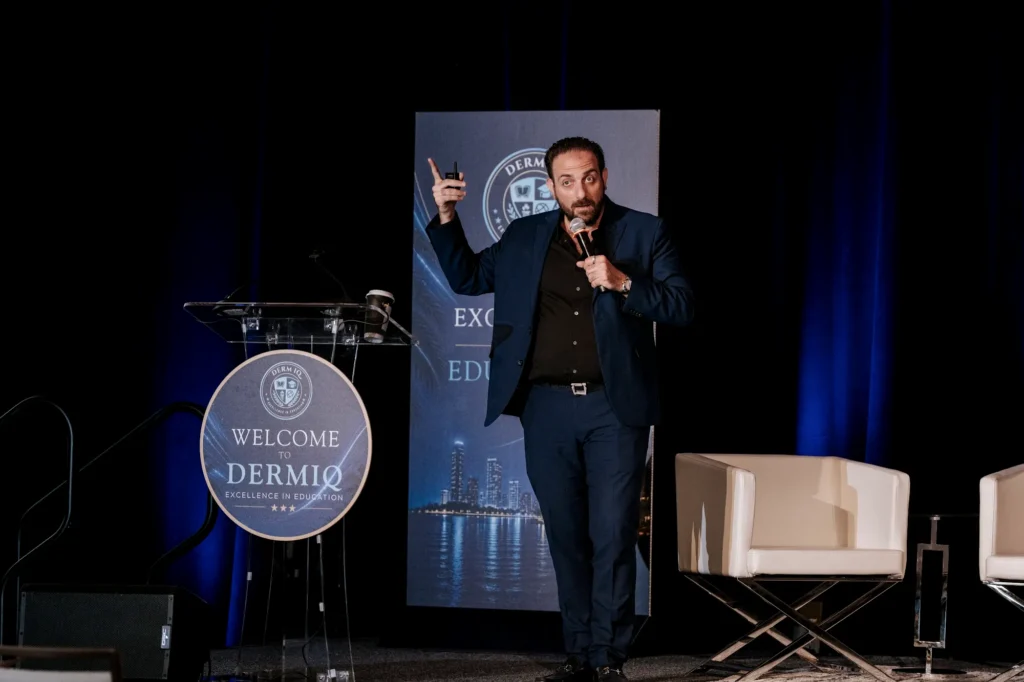
This frame was on the main stage at the DermIQ Summit 2026, and it carries into the DermIQ Dermato-Allergy Exchange, March 13 to 14, 2027, in Tysons Corner, VA. The tentative agenda, subject to change, includes "Dermatology Pearls for the Non-Dermatologist." To hear about new case-based content between meetings, join the newsletter.
Education for every clinician who touches skin. Written for clinicians, not as advice for patients. Questions or a case to share? Write to us.